Frequently Asked Questions
Filter by tag:
What is the proposed Heath Hills subdivision?
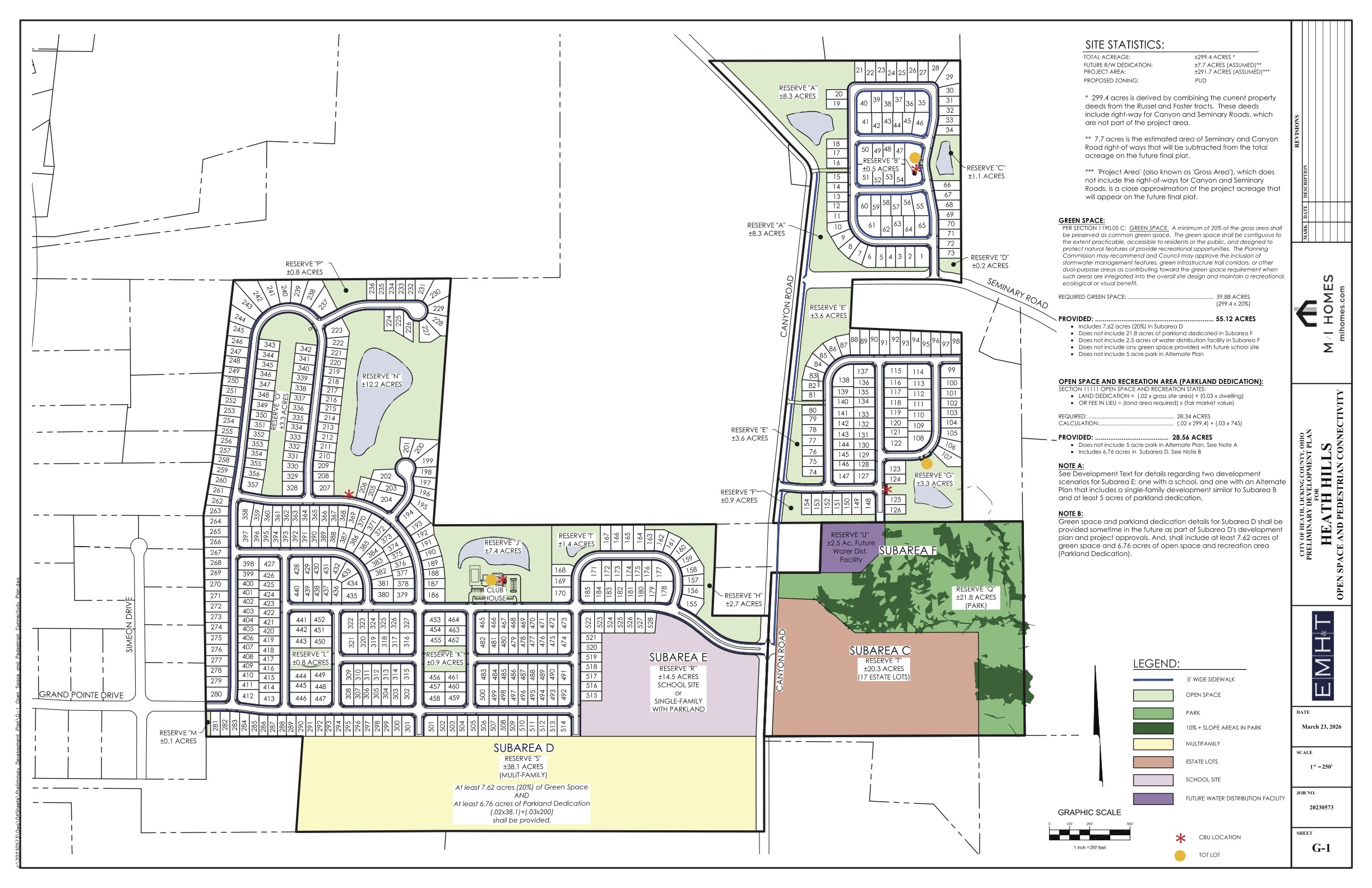
Heath Hills is a large-scale residential development proposed by M/I Homes of Columbus on approximately 225–300 acres of farmland annexed into the City of Heath from Union Township. The plan calls for roughly 550–600 single-family homes, ranging in price from the mid-$500,000s to the $700,000s, along with, a swimming pool, clubhouse, and a conditional 14.5-acre site donated for a potential future Granville elementary school.
Construction is expected to proceed at a pace of 70–80 homes per year over 8–10 years. While the development is in Heath, all homes fall within the Granville Exempted Village School District boundaries.
Where is Heath Hills located and why does it affect Granville?
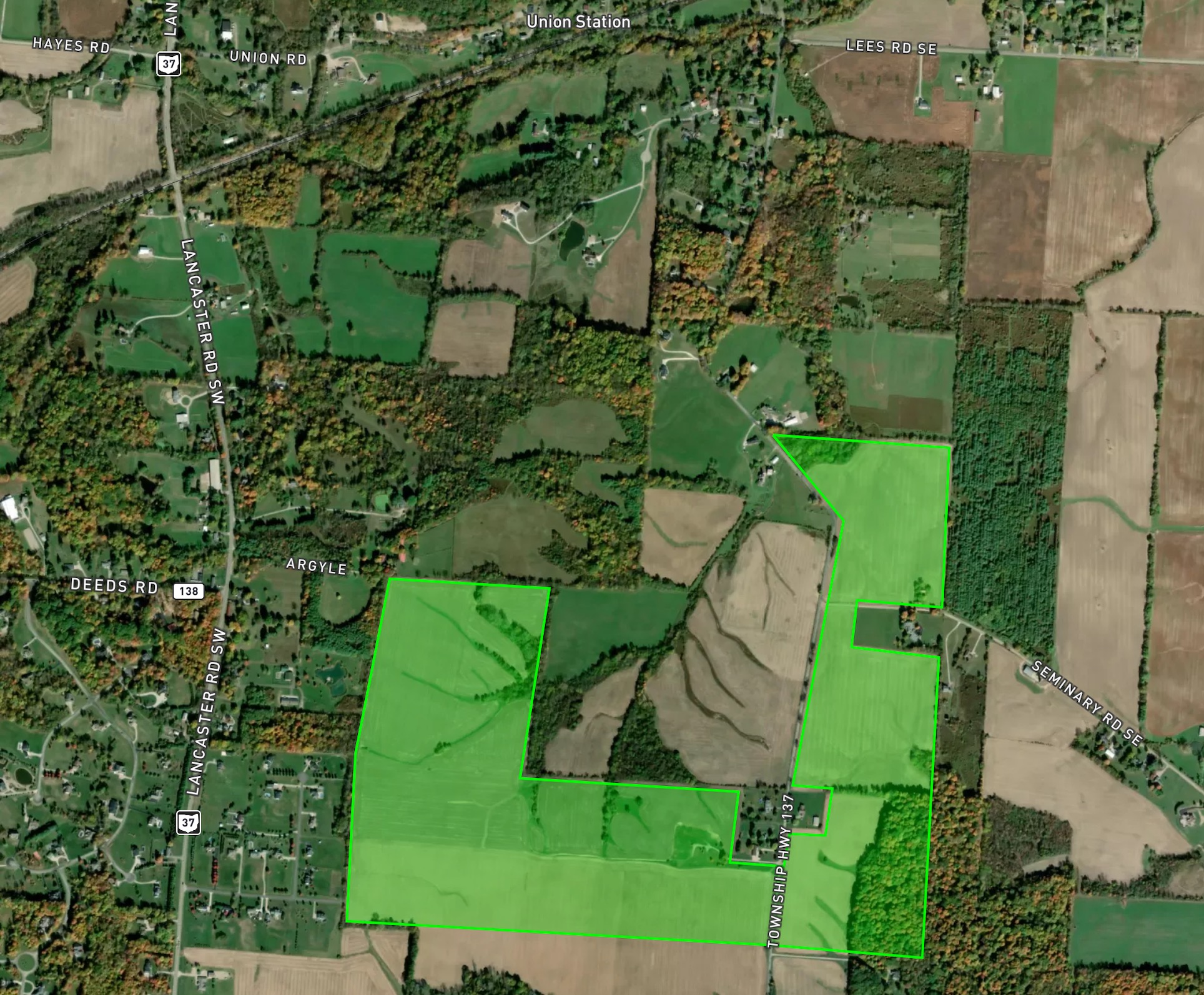
The subdivision is located south of Granville along the east side of Rt. 37, around the intersection of Seminary Road and Canyon Road. Although the land is now part of the City of Heath, it remains entirely within the Granville school district.
This creates a classic mismatch: Heath gains tax revenue, development fees, and economic benefits, while Granville schools must absorb all the new students and associated costs with no ability to control the project or adjust density to a model that would fit with the community.
How many homes and what density is proposed?
M/I Homes is seeking approval for 550–600 homes with a minimum lot size of ⅙ acre. This is dramatically higher than surrounding areas and the sustainable model that this region was built on.
Granville Township and Union Township typically allow 1 home per 5 acres, or as little as 2 acres in a planned development with green space.
The adjacent Grand Pointe subdivision has 1 home per 2 acres
Developers and Heath officials claim this density is “as low as the company can go,” but critics note it maximizes financial impact on Granville.
How many new students will it add to Granville schools?
The Granville Schools hired an independent enrollment consultant (Wolpert Inc./Cooperative Strategies) to analyse the likely growth in students. Using analytical models based on past housing growth in Granville, they created an accurate model of expected enrollment growth. The model predicts a peak average number of students per house of 1.6. At the current density this development alone is projected to add an estimated 960–1,000 new students to Granville’s current enrollment of roughly 2,500–2,600 students - an increase of 35-40%. Incremental growth is to be expected, but this level of additional students will disrupt the educational model of students, overwhelm facilities and stress.
Granville Elementary and Intermediate schools are already operating at or near 95% capacity. Without significant new construction, the district will quickly need modular classrooms or other temporary solutions, with long-term needs for enormous capital investments for additional buildings at all levels.
What are the estimated costs to Granville schools and taxpayers?
The district projects an additional $12 million per year in operating costs for these new students once fully built out, plus up to $55 million in capital costs for new and expanded facilities. State funding does not increase with enrollment growth or cover new construction in this scenario. Unlike other districts in Licking County, the state also does not support new building construction for Granville Schools.
If approved at the current proposed density, this shortfall will require major local property tax increases of 14.5 mills. Estimates suggest over $2,000 on average per household annually or roughly a 30% property tax hike for existing Granville property owners, severely impacting seniors, long term residents, and families on fixed incomes. Lower density or a different home product mix would significantly lower tax burden.
Visit the Financials page for a detailed breakdown.
Why was Heath Mayor Mark Johns named BIA of Central Ohio Citizen of the Year?
The Building Industry Association (BIA) of Central Ohio is the trade group representing home builders and developers in the region, including M/I Homes. Each year at their “Big Night” gala they present a Citizen of the Year award to a non-BIA member who has provided “major benefits to the community and the building industry.”
In 2025 Mayor Mark Johns received this award. The timing coincides with his strong public support for M/I Homes’ proposed 550–600 home Heath Hills subdivision - a project that would deliver significant new housing units to Columbus builders.
Questions have been raised about what specific service to the builders earned the mayor this recognition, especially given his defense of the project’s high density despite strong objections from Granville schools and residents. The award highlights the close relationship between local elected officials and the development industry at a time when critical zoning decisions for Heath Hills were pending before Heath City Council.



Won’t new tax revenue from the subdivision cover Granville’s increased education costs?
No. New homes are estimated to generate only about $3.3 million annually in property and income taxes for Granville schools - far short of the over $12 million in added operating expenses.
Compounding the issue, Heath plans to impose a 6.5-mill in perpetuity property tax surcharge on these subdivision homes in Granville Schools that will go entirely to the City of Heath. None of the funding was offered to support the schools.This leaves Granville bearing the full educational burden without any revenue sharing. In contrast, the Park Trails development (located in Newark but also in the Granville School District) established a 20-year property tax special assessment that is used to support Granville Schools infrastructure, showing that more equitable solutions are possible. It should also be noted that Park Trails has less density and fewer homes than the proposed Heath Hills.
Visit the Financials page for a detailed breakdown of income vs expenses.
Why is the high housing density so controversial?
The proposed density maximizes homes (and therefore students) on the land, creating an overwhelming burden on Granville schools and infrastructure. It directly contradicts the collaborative FRAMEWORK regional growth plan that Heath and Granville officials previously supported to avoid exactly this kind of exploitative development.
Granville officials have described it as “grotesque exploitation” of Granville’s high-quality schools and taxpayers for the benefit of Heath and the developer. It turns Granville schools into the primary selling point for a Heath subdivision while shifting all costs to Granville residents.
What is Ohio Senate Bill 173 (SB 173) and why does it matter here?
SB 173 is legislation introduced in 2025 that would reform how school district boundaries are handled when a city annexes land. It would make it easier in certain cases (especially large “megaproject” developments) for school district lines to automatically transfer with the annexed territory - so the annexing city’s school district would serve the new residents.
Granville officials have strongly supported the principles behind SB 173 because it would prevent situations like Heath Hills, where Heath controls zoning and collects taxes but Granville bears the full cost of educating nearly 1,000 additional students. Without such reform, the current system allows exactly this kind of cost-shifting.
How does Ohio’s school funding system affect this project?
Because Granville is on a state funding guarantee, it will receive zero additional dollars from the state for these new students. If these students were added to other school districts, the state would provide additional funding. The gap between the $3.3 million in new local taxes and the $12 million in projected costs would likely require significant tax increases for all current Granville School District residents.
What other impacts will the subdivision have on traffic, infrastructure, and the community?
Major concerns include severe congestion and safety issues on already-challenged Rt. 37 and local roads through the existing neighborhoods like Grand Pointe, and Canyon and Seminary roads. M/I Homes has offered limited improvements (such as a turn lane), but the rapid addition of hundreds of homes will cause huge traffic and safety problems in the region.
The proposal requires 12 zoning deviations. Residents fear loss of farmland, reduced property values if schools become overcrowded or underfunded, and long-term pressure on Granville’s quality of life and tax base.
What have the developer and Heath mayor said, and what is the full picture?
M/I Homes states the proposed density is “as low as the company can go.” Heath Mayor Mark Johns has defended higher density, arguing it preserves more farmland overall while meeting housing demand. He notes ongoing conversations with Granville Superintendent Jeff Brown and inclusion of a school site.
However, these statements do not fully address the core imbalance: Granville bears nearly all education costs and student impact while receiving far less revenue. The mayor previously collaborated on the FRAMEWORK plan precisely to prevent developments that “bulldoze over” neighboring school districts. Granville leaders continue to urge reduced density and revenue sharing.
What can Heath City Council members and local residents do to address these concerns?
The Heath City Council still has final approval authority. They can:
- Remand the project to planning to consider sustainable options.
- Require a significant reduction in housing density to better match surrounding neighborhoods
- Mandate stronger infrastructure contributions or shared revenue with Granville schools
- Impose conditions that protect neighboring taxpayers and schools
Residents of both Heath and Granville can attend the upcoming Heath City Council public hearing onMay 11 and urge council members to prioritize responsible, neighborly growth. They can also contact the Heath City Council members by email or by phone and voice their concerns anytime before the regular Heath City Council Meeting on May 18th. Public pressure has influenced similar projects in the past.
Have a question not answered here?
Send us a message and we will get back to you as soon as possible.